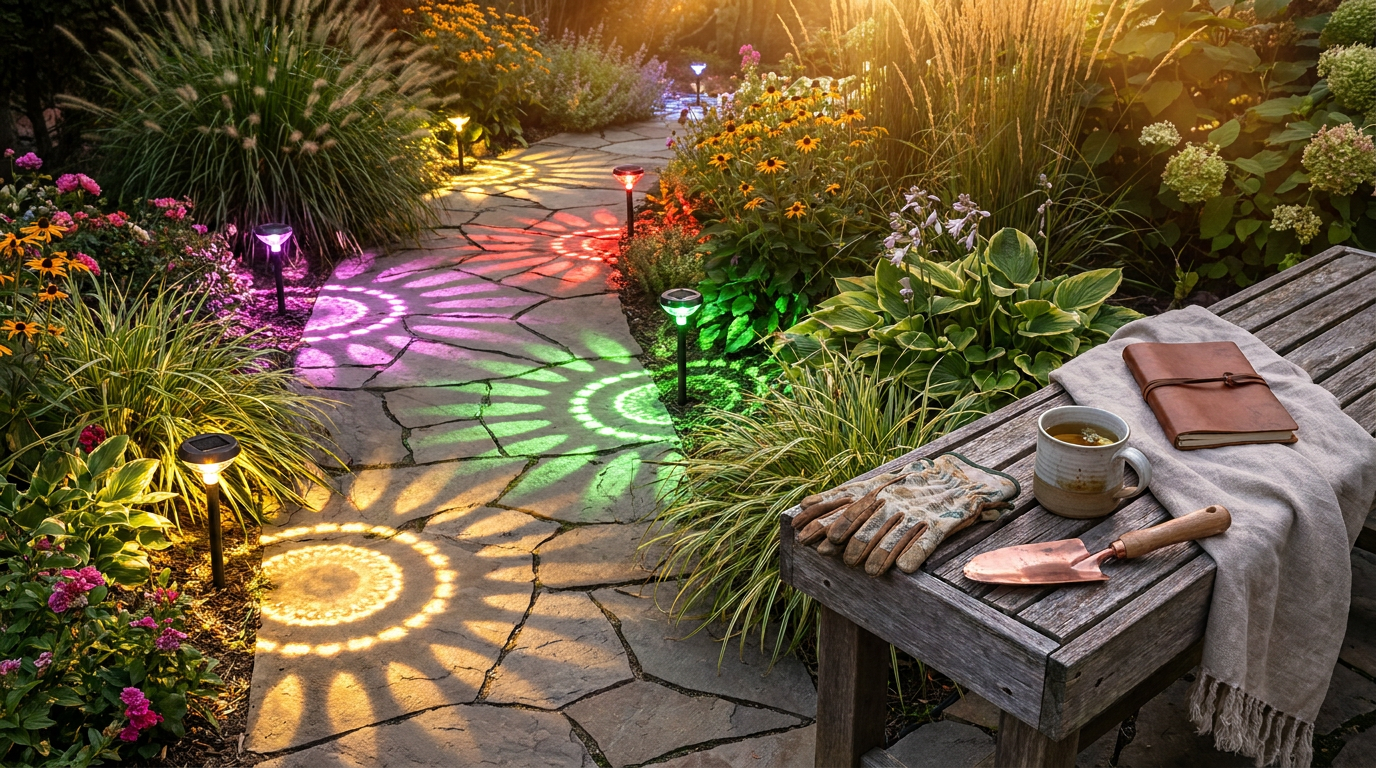
Bloom Path Lights and Modern Floral Walkway Design
 Maya ChenContributing Editor
July 23, 2026. This analysis explores the technical and aesthetic requirements of modern floral walkway lights. It is intended for homeowners and landscape designers seeking to balance floral aesthetics with durable outdoor illumination hardware.
The Failure of Standard Utility Lighting
The conventional wisdom says that path lighting should be as invisible as possible, focusing purely on lumen output and ground-level visibility. However, this approach creates a sterile, industrial aesthetic that frequently clashes with organic garden designs. According to Kichler, path lights are traditionally used to highlight low-growing foliage in landscaping beds, yet most market options rely on harsh, geometric shapes that fail to complement the very flora they are meant to illuminate. Here's the part nobody talks about: the visual disconnect between a soft, natural garden and a rigid, metallic light fixture creates a jarring experience at night. When we look at the Pinterest landscape community's fascination with concepts like the Cherry Blossom Walkway, we see a clear demand for lighting that mimics or enhances botanical forms rather than competing with them. Most modern path lights, as noted by 2Modern, are built with weather-resistant materials like powder-coated aluminum and marine-grade steel to ensure longevity, but durability is often used as an excuse for poor design. A light that lasts twenty years but looks like a piece of construction equipment in a flower bed is a failure of intent. To truly integrate outdoor decorative bloom lighting, the hardware must function as a sculptural element. We see this in the shift toward decorative floral walkway lights that prioritize the silhouette of the fixture as much as the light it casts. The current market oversaturates with "disappearing" fixtures, but for a modern walkway, the fixture must exist as a deliberate part of the landscape's daytime and nighttime identity.
Engineering the Bloom Path Lights Aesthetic

Bloom Path Lights rejects the notion that a fixture must be either a hidden tool or a gaudy ornament. By focusing specifically on the floral form factor, these lights solve the aesthetic gap left by traditional bollards. The engineering behind Bloom Path Lights centers on the diffusion of light through petal-inspired geometries, which prevents the "hot spot" glare common in cheap LED stakes. When integrating bloom landscape lighting for patio areas, the height of the fixture becomes a critical variable. Run the math: a standard 12-inch stake often gets lost behind mid-summer perennial growth, rendering the light useless for safety. Bloom Path Lights are designed to maintain visibility above low-level foliage while casting a downward-focused beam that meets the functional requirements of walkway safety. This is not merely about looking like a flower; it is about utilizing the physics of a flower's shape to shield the light source from the eye while spreading it across the path surface. This dual-purpose design allows for a more cohesive decorative floral walkway lights installation that feels intentional rather than additive. Unlike the generic marine-grade steel cylinders that dominate the "modern" category, these fixtures use their structural curves to soften the transition from the hardscape of a walkway to the softscape of a garden bed. This is particularly effective when used as bloom landscape lighting for patio borders, where the proximity to seating makes the visual quality of the fixture itself a primary concern for the homeowner.
A Decision Framework for Floral Illumination
Choosing a floral-inspired light requires more than an appreciation for the shape; it requires a rigorous assessment of how the light interacts with the specific biology of your garden. A modern floral walkway is a dynamic environment where plant heights change and seasonal colors shift. To ensure your lighting remains effective year-round, you must evaluate fixtures based on their architectural contribution to the space. I'll change my mind when a standard minimalist bollard can provide the same level of organic integration as a bloom-specific design, but until then, the following criteria should guide your selection:
- Fixture Height: Ensure the lighting head sits at least 3-5 inches above the expected maximum height of your groundcover to avoid light blockage.
- Material Finish: Match the metal finish to your existing hardscape; Bloom Path Lights offer finishes that complement both modern concrete and traditional stone.
- Light Distribution: Look for a 360-degree downward wash that avoids blinding pedestrians while highlighting outdoor decorative bloom lighting patterns.
- Voltage Compatibility: Verify that the system integrates with standard 12V transformers for ease of installation and maintenance.
- Seasonal Versatility: Evaluate how the fixture looks in winter when the surrounding foliage is gone; it must stand alone as a sculptural element.
Sources

Photo by Quang Nguyen Vinh on Pexels
- 280 Best Pathway Lighting ideas | landscape ...
- Modern Path Lights
- Landscape Path Lighting & Pathway Lights